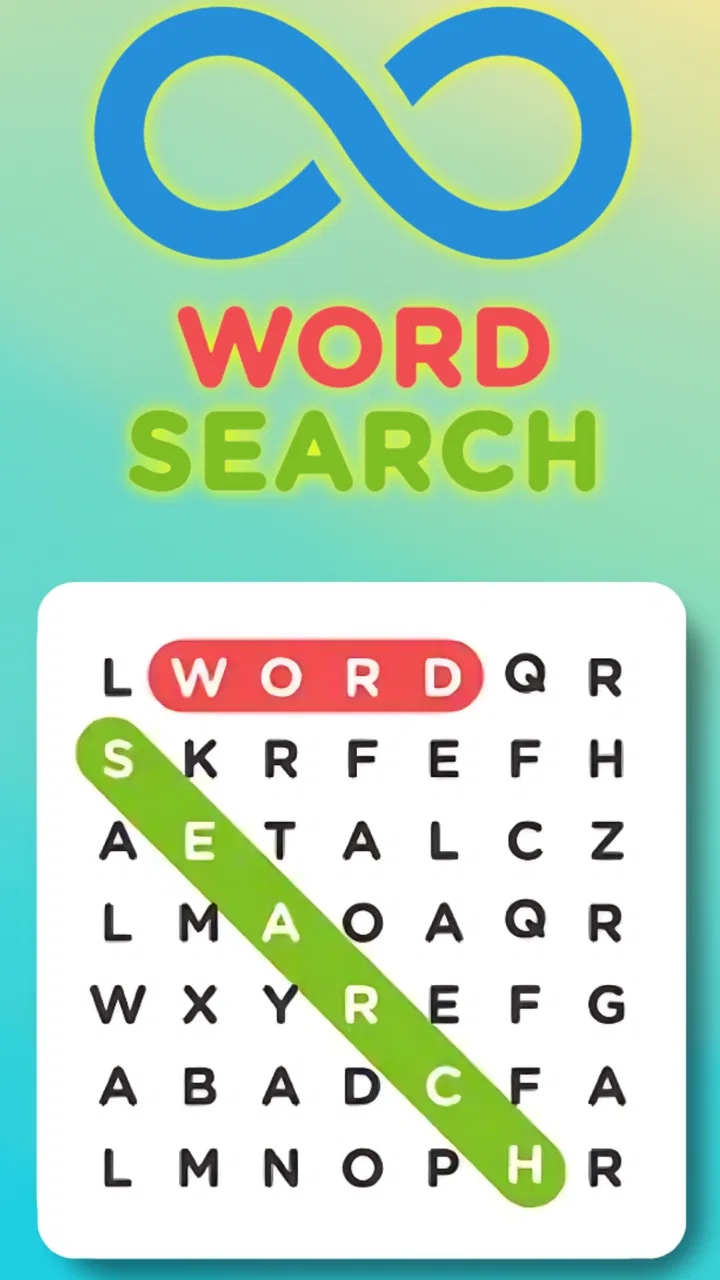
Infinite Word Search Puzzles
- 4.7
- Rating
- 10.00M
- Installs
- Free
- Price
 Analysis by App-foxy
I enjoy word games most when they are easy to open, quick to understand, and flexible enough to fit around real life. Infinite Word Search Puzzles takes that approach with a large collection of themed word-search boards rather than a story, timer-driven challenge, or complicated progression system. I can pick up a puzzle for a short break, stay with it longer when I want something more relaxing, and return to a familiar style of play without learning new rules.
Developed by Random Logic Games, LLC, this free word game has built a strong audience, with a 4.7 average from around 80 thousand ratings and more than 10 million installs. Those figures suggest that its simple format has broad appeal, but they do not automatically make it right for everyone. In my experience, the real question is whether you enjoy scanning letters at your own pace and whether a very large puzzle library matters more to you than elaborate features.
How Infinite Word Search Puzzles feels in everyday use
I find the everyday appeal here is less about chasing a score and more about choosing a theme that fits the moment: a familiar subject can make a brief puzzle feel welcoming, while an unfamiliar one gives me a reason to slow down and look closely. I’d also treat screen comfort as part of the choice, since careful scanning is more pleasant when glare and interruptions are low. That leads naturally to how the game’s feedback shapes each session.
You May Also Like

 Pandora - Music & Podcasts
Pandora’s Music Is Easy to Start, but Harder to Recover
Pandora’s strength is its low-effort path from a seed to a station. Its weak spot is how much confidence it asks you to place in connection, setup, and quiet recovery.

 8 Ball Pool
 Is Built on Rivalries, Rematches, and Routine
A close look at the rivalries, rematches, shared routines, and unanswered safety questions that turn a quick pool match into a persistent mobile community.

 Samsung Music
’s Quiet Strength Is Playing What You Already Own
Its reach comes less from spectacle than from dependable access to a personal library. That simplicity is both the app’s strongest retention engine and its ceiling.

 AccuWeather: Weather Radar
AccuWeather Review: A Quick, Clear Forecast for Everyday Decisions
For everyday plans, the best forecast is the one you can understand quickly. AccuWeather makes rain timing, radar, and local conditions easy to act on, with a few trade-offs.

 Hill Climb Racing
Why Hill Climb Racing Still Turns Crashes Into One More Run
A tiny car, a bumpy hill and one more upgrade: Hill Climb Racing keeps resurfacing because its simple chaos makes every near-miss feel personal.

 AliExpress - Shopping App
AliExpress Makes Global Shopping Feel Personal, but Shoppers Bear the Risk
AliExpress turns a global marketplace into a pocket-sized discovery engine. Its reach is useful, its shopping loop compelling, and its trade-offs easy to miss.
More From Our News Desk
View All News


Fast to understand, with a deliberately simple rhythm
The first thing I notice about this type of game is how little preparation it demands. I do not need to remember a storyline, build a character, or understand a complicated menu before playing. The basic task is familiar: look through a grid, find the listed words, and mark them. That makes it a natural choice for a commute, a waiting room, or a few quiet minutes before bed.
The title’s emphasis on “infinite” is useful in a practical sense. The game is built around thousands of word-search puzzles and more than 300 categories, so I am not limited to one narrow theme. That variety helps prevent the experience from feeling like I am solving the same board repeatedly, especially when I choose topics that match my mood.
At the same time, the straightforward design can feel modest if I am looking for a richer game loop. There is no reason to expect the strategic depth of a crossword, the vocabulary experimentation of a word-building game, or the competitive pressure of a timed multiplayer title. Its strength is repetition with variety, not transformation of the genre.
Why the speed matters more than flashy presentation
For a word-search game, perceived speed is mostly about how quickly I can move from opening the app to making progress. Infinite Word Search Puzzles benefits from having a clear central activity. I am not dependent on a long tutorial or a complex setup to enjoy a board. That makes it suitable for short sessions where a few seconds of friction would otherwise be annoying.
My advice is to judge the game by the smoothness of its basic interaction rather than by expecting console-style presentation. The appeal is the immediate visual search: scan rows, columns, and diagonals, then mark a word when I spot it. If I prefer calm concentration, this pace works well. If I need constant animation, dramatic rewards, or rapidly changing objectives, the simplicity may feel slow even when the app itself feels responsive.
A useful habit is to choose a category before I am already tired or distracted. When I open a puzzle with a theme I recognize, I can use my existing vocabulary to search more efficiently. That small choice makes the game feel faster because I spend less time mentally adjusting to unfamiliar words.
What happens during longer sessions
Short play is where this game makes the strongest case for itself, but longer sessions reveal a different trade-off. A large library gives me plenty to explore, yet the central action remains the same from one board to the next. After several puzzles, I may notice that my attention, rather than the game, becomes the limiting factor.
That is not necessarily a flaw. Word searches can work as a low-pressure concentration exercise, and the repeated scanning can be pleasantly meditative. Still, I would not choose it as my only game for a long flight if I wanted changing mechanics. I would pair it with another genre and use this one when I want a predictable mental activity.
Heavy use also makes category selection more important. Instead of moving randomly through the library, I get more value by choosing a topic connected to a personal interest, school subject, travel plan, or vocabulary goal. The game’s breadth becomes more meaningful when I treat the categories as a way to shape the session rather than simply as a large number to browse.
Stability and the practical meaning of recovery
A word-search app has a relatively focused job, so reliability matters more than spectacle. I want to be able to return to a puzzle, understand what I was doing, and continue without unnecessary confusion. The uncomplicated nature of the game helps here: even if I leave after a short session, the rules are easy to remember when I come back.
I also appreciate that this is the kind of title I can mentally pause at almost any point. If I am interrupted by a message, a conversation, or an arriving bus, I do not lose the thread of a complicated battle or timed sequence. I simply return to the grid and resume searching. That makes it more forgiving than many games designed around uninterrupted attention.
There is an important distinction between recovery and guaranteed persistence, however. I would not treat any casual puzzle app as the only place to keep notes or track personal progress. If I am working through a particular theme for learning, I might write down useful words separately. That workflow turns the game into a supplement for practice rather than a substitute for a dedicated vocabulary tool.
Resource expectations and device limitations
The game is available for devices running at least version 8.1 of its operating system, which gives it a broad compatibility range. It is also rated for Everyone, so its basic content is appropriate for a wide audience. Parents should still remember that an age rating describes content suitability, not whether every child will find the reading level or visual searching comfortable.
Because the core activity is a letter grid, I would expect the experience to be less demanding than graphically intensive games. That makes it a sensible option for someone who wants a lighter word-game experience rather than a title built around elaborate visual effects. I would still keep enough free storage and update the device normally, especially on older hardware, but I would not choose this game for graphics performance in the first place.
Screen size can affect comfort more than raw device power. On a small phone, closely packed letters may require more careful tapping and longer sessions could strain my eyes. A larger display can make scanning easier, particularly when I am solving a dense board or playing with reduced brightness. If I often use an older or compact device, I would test one puzzle before committing to extended sessions.
Another practical constraint is attention. Word searches look simple, but finding a hidden word can become frustrating when I am tired, in bright sunlight, or surrounded by distractions. I get better results when I reduce glare and hold the device steadily. That is not a special feature of the app, but it changes how enjoyable this particular visual format feels.
Free access, optional spending, and what to watch for
The game is free to download, which makes it easy to try without making an upfront commitment. It also includes in-app purchases ranging from $0.99 to $49.99 per item. I would keep that range in mind before handing the device to a child or leaving purchasing enabled, particularly because a large content library can encourage frequent browsing.
My approach would be simple: play enough free content to decide whether the basic search experience is genuinely enjoyable, then consider spending only if the purchase removes a specific annoyance or adds value to the way I use the app. Buying something just because the game offers many categories would not automatically improve the core activity. The important question is whether I want convenience and variety, not whether I can unlock more for its own sake.
This pricing model also affects who should skip the game. If I strongly dislike optional purchases, promotional interruptions, or the possibility of being tempted by extra content, a paid word-search app with a clearer one-time model may feel more comfortable. If I am happy to try a free title and make careful choices, the entry point is much friendlier.
How it compares with other word games
Compared with crosswords, Infinite Word Search Puzzles asks less of me in terms of clue interpretation. I do not need to solve a definition or infer an answer from intersecting letters; I mainly need to locate words in the grid. That makes it more approachable when I want relaxation, but less satisfying if I enjoy complex clues and the sense of constructing an answer.
Compared with word-building games, it is less strategic. There is no need to weigh letter values, manage a rack, or plan a chain of moves. The benefit is that I can start immediately and stop easily. The cost is that experienced players may find the decision-making shallow after the novelty of a category wears off.
Compared with a single-theme word-search collection, the broad category range is the main attraction. I can move from one subject to another instead of exhausting one narrow vocabulary set. The trade-off is that a huge library can feel less curated. I may need to spend time choosing what to play, whereas a focused app might deliver a more deliberate educational or thematic experience.
For children or learners, I would use it as a casual reinforcement tool rather than a complete lesson. Searching for words can support recognition and spelling familiarity, but it does not explain definitions, pronunciation, grammar, or context by itself. A dictionary, reading activity, or dedicated language app would be better when learning is the primary goal.
Who will get the most from it
I think this game suits people who enjoy quiet visual puzzles, especially those who want sessions that can last a few minutes or stretch longer without requiring a major commitment. It is also a good match for players who like themed content and want more choice than a small fixed puzzle pack can provide.
It may work well for families because the Everyone rating keeps the content broadly accessible, although younger players may need help reading some words or navigating purchases. Older players who prefer familiar puzzle rules may appreciate the lack of a steep learning curve. The game can also be a pleasant alternative to endless scrolling when I want something mildly absorbing but not emotionally intense.
I would skip it if I need advanced vocabulary instruction, competitive leaderboards, rich storytelling, or a game that changes mechanics frequently. I would also look elsewhere if I find letter scanning tiring or if I prefer solving clues over visually locating answers. The large audience and high rating do not change those personal fit issues.
Development, support expectations, and version context
Random Logic Games, LLC has kept this title in circulation since its release on August 6, 2015. Its current version is 5.1.8, which places the game in the category of an established mobile title rather than a brand-new experiment. That history is reassuring for someone who wants a familiar, mature format, although it also means I would not approach it expecting the newest design trends in mobile gaming.
The long-running nature of the game makes the large selection more believable as part of its identity, but it does not remove the need for personal testing. Device behavior, screen comfort, and tolerance for optional purchases vary considerably. I would install it, solve a few different categories, and see whether the experience remains pleasant after the first easy board.
One of my favorite ways to use it is as a transition activity. After work, I can play one puzzle before moving to another task, using the focused search to step away from notifications without committing to a full game session. The key is to set my own stopping point. Since the format is easy to continue, it can become more time-consuming than intended if I keep selecting “just one more” category.
My performance verdict
Infinite Word Search Puzzles succeeds because it keeps its promise narrow and understandable: it gives me a substantial supply of themed word searches in a free package that is easy to approach. Its perceived speed comes from the direct route into a puzzle, while its light, repeatable format makes it suitable for older compatible devices and interrupted sessions.
The weaknesses are equally clear. The gameplay can become repetitive, visual searching is not comfortable for every screen or every player, and the optional purchase range means I should pay attention before spending. It is not a replacement for a crossword, a vocabulary course, or a more strategic word game.
My recommendation is positive for anyone who wants a calm, flexible word-search collection and is comfortable with a simple core loop. I would start with the free experience, try several categories rather than judging it from one board, and use a larger screen or shorter sessions if scanning becomes tiring. The best reason to choose it is dependable simplicity with plenty of themed variety, not advanced game mechanics.
For me, that makes it an easy title to keep available for small pockets of time. It will not satisfy every kind of word-game fan, but when I want to focus on letters, avoid complicated rules, and leave the game whenever real life interrupts, it does the job well.
FAQs for Infinite Word Search Puzzles
01What is Infinite Word Search Puzzles and how does it work?
Infinite Word Search Puzzles is a mobile game available for both Android and iOS platforms. It offers a wide array of themed word search puzzles that challenge your vocabulary and puzzle-solving skills. The game features multiple categories, multiplayer modes, and timed challenges to keep players engaged. Users can enjoy both single-player and competitive modes to test their skills against others.
02Are there any in-app purchases in Infinite Word Search Puzzles?
Yes, Infinite Word Search Puzzles includes in-app purchases. While the game is free to download and play, users can purchase additional features such as ad-free experiences, hints, and extra puzzle packs. These purchases are optional and designed to enhance the gameplay experience for those who wish to explore more content or advance more quickly.
03Does Infinite Word Search Puzzles require an internet connection?
Infinite Word Search Puzzles can be played offline for single-player modes, making it convenient for users without a constant internet connection. However, if you want to participate in multiplayer challenges or access certain features, an internet connection is required. This allows for real-time competition and leaderboard updates.
04How frequently are new puzzles added to Infinite Word Search Puzzles?
The game developers regularly update Infinite Word Search Puzzles with new content. This includes new puzzles, categories, and features to keep the gameplay fresh and engaging. Updates are typically rolled out through the app stores, so it’s recommended to keep your app updated to enjoy the latest content and improvements.
05Is Infinite Word Search Puzzles suitable for children?
Infinite Word Search Puzzles is suitable for players of all ages, including children. The app has a simple and intuitive interface, making it easy for younger players to navigate. Additionally, the educational aspect of the game can help improve vocabulary and spelling skills. Parental supervision is advised for in-app purchases to prevent unintended purchases.
Pros
- Wide variety of word search themes.
- User-friendly interface for easy navigation.
- Daily challenges keep gameplay fresh.
- Multiplayer mode adds competitive fun.
- Offline play available for travel.
Cons
- Ads can be intrusive during gameplay.
- Limited hints without in-app purchases.
- Some puzzles may repeat over time.
- Multiplayer requires stable internet.
- No customization of puzzle themes.

Infinite Word Search Puzzles
Gallery